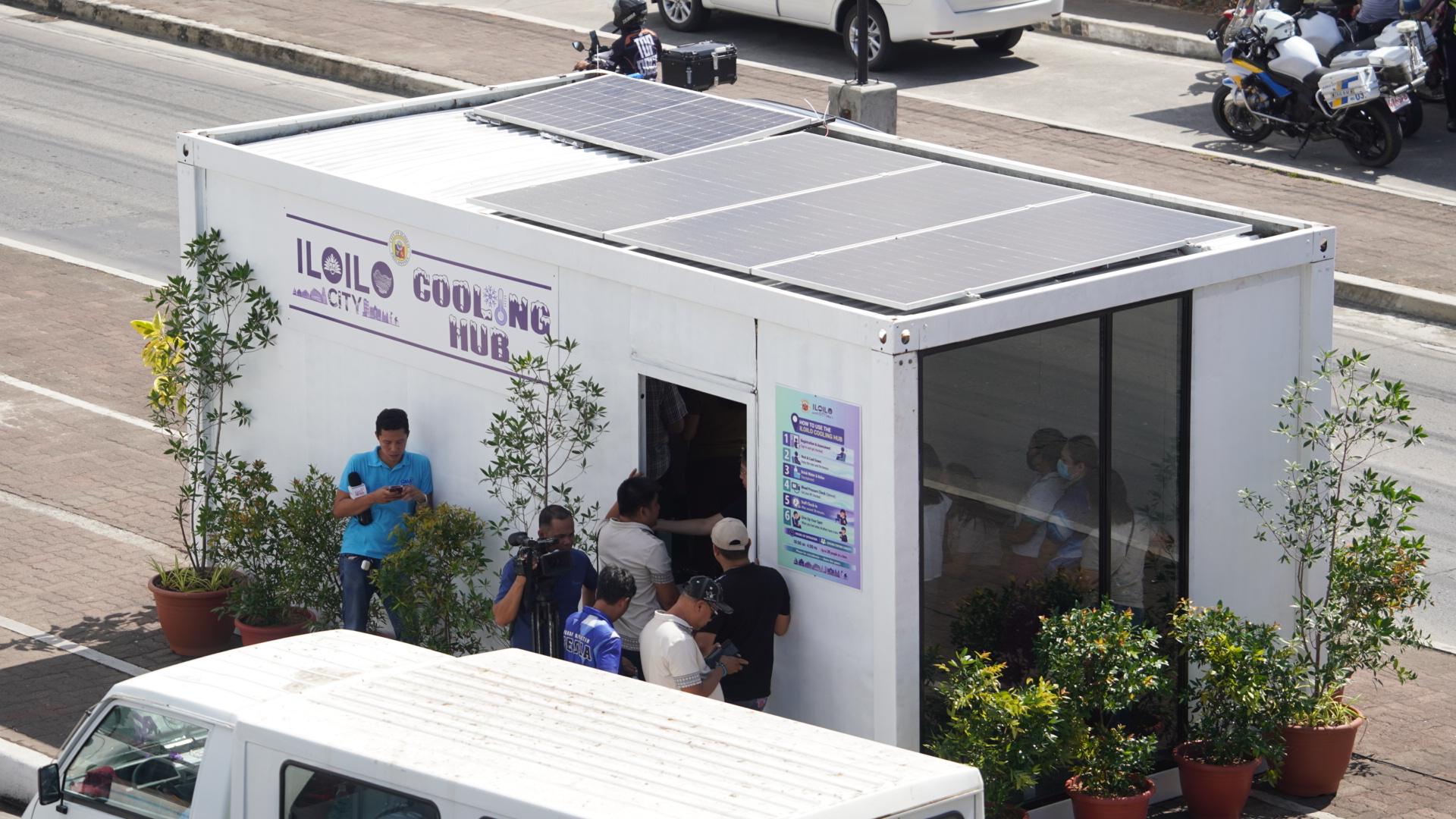
ILOILO CITY — On May 6, 2026, the Iloilo City government opened two public cooling hubs along Diversion Road in Mandurriao and General Luna Street near Jalandoni Bridge, with a third unit being installed at Plazoleta Gay. The activation is a direct response to heat indices that have reached a scorching 46°C in Dumangas and 43°C in the city itself, levels that fall squarely within the "danger" classification. For the real estate sector, these solar-powered, circular-economy shelters are far more than a public health measure. They represent a new asset class in urban livability, one that developers and investors are beginning to factor into property valuations across Iloilo's already booming market.
The hubs are modest in scale—each accommodates 20 persons at a time, operates from 10 a.m. to 4 p.m., and offers air conditioning, drinking water, and on-site medical personnel. But their strategic placement in high-foot-traffic corridors reveals a city government that understands how public infrastructure shapes neighborhood desirability. In an era when homebuyers increasingly weigh climate resilience alongside price per square meter, the presence of government-backed cooling stations sends a message that the local government is engineering its streetscapes for human safety even as temperatures climb.
Solar-Powered and Circular by Design
Each I-Cool hub, as the city has branded them, runs on solar panels capable of generating one kilowatt of power. The container vans were repurposed from previous city projects, the chairs and tables fabricated from recycled plastic waste, and the flexible flooring salvaged from earlier municipal uses. General Services Office head Neil Ravena noted that the facilities could be the first circular-economy-inspired public cooling hubs in the country.
When the heat season ends, the units will be converted into rain shelters equipped with water collection systems. This dual-use design philosophy matters to real estate stakeholders because it demonstrates that the city's climate infrastructure is not disposable. It is built to pivot across seasons, reducing the long-term fiscal burden on the local government and, by extension, the taxpayers who fund it. For developers marketing properties in Mandurriao and City Proper, the cooling hubs become a permanent locational amenity rather than a temporary relief measure.
Where Cooling Meets Property Value
The hubs sit along two of Iloilo's most traversed corridors. Diversion Road in Mandurriao is a spine of commercial and residential growth, while General Luna Street in City Proper anchors the historic downtown. These are precisely the kinds of locations where heat stress has the greatest economic impact—deterring foot traffic, shortening retail dwell times, and making commutes punishing for residents.
Urban studies have long linked extreme heat to depressed property values in neighborhoods that lack cooling infrastructure. By installing temperature-controlled public shelters, the city is effectively lowering the heat-risk profile of adjacent barangays. For a condominium buyer comparing two similarly priced units, the one within walking distance of a cooling hub and its attendant shade, hydration, and medical support carries a subtle but real premium. In a market where Colliers Philippines reports a 96 percent take-up rate for house-and-lot packages and 89 percent for condominiums, these micro-infrastructure advantages can tip purchase decisions.
Private Sector Steps In to Expand the Network
The initial three hubs will not stand alone for long. During the May 6 opening, Mayor Raisa Treñas-Chu announced that at least three to four private companies have committed to installing additional I-Cool stations outside their establishments, with a coordination meeting scheduled in the days following. The expansion transforms the cooling network from a government pilot into a public-private infrastructure layer, one that could eventually dot the entire city.
The private sector's willingness to invest in cooling hubs signals that businesses recognize the commercial cost of an overheated streetscape. A retail establishment or office building that offers adjacent cooled shelter attracts customers and tenants who might otherwise stay home during peak heat hours. For Megaworld, which now controls 48 percent of Iloilo's office market and operates the 72-hectare Iloilo Business Park employing nearly 100,000 workers, cooling infrastructure complements the LEED gold certifications already attached to its Enterprise towers. The model GenSan can expect is deepening integration rather than isolated pilots.
Livability as Iloilo's Long-Term Property Anchor
The cooling hubs did not emerge in a policy vacuum. They follow the city's institutionalization of heat safety protocols in April 2026, the launch of the Green Resilient Home model along the Iloilo River Esplanade, the turnover of the Purok Resilience Village in Batad, and the Luntiang Bukas program's distribution of 820 land titles across Western Visayas. Each initiative reinforces the same message: Iloilo is building a climate-adaptive city, and climate-adaptive cities command higher property values over time.
Iloilo City has already recorded the highest number of office transactions outside Metro Manila for the first quarter of 2026, outpacing Metro Cebu. Its residential take-up rates are the strongest in the Visayas-Mindanao region. The cooling hubs add a visceral, street-level proof point to the statistics. When a buyer walks down Diversion Road and sees a solar-powered, staffed cooling station, the city's sustainability narrative becomes tangible. In a competitive regional property market, tangibility converts to sales.