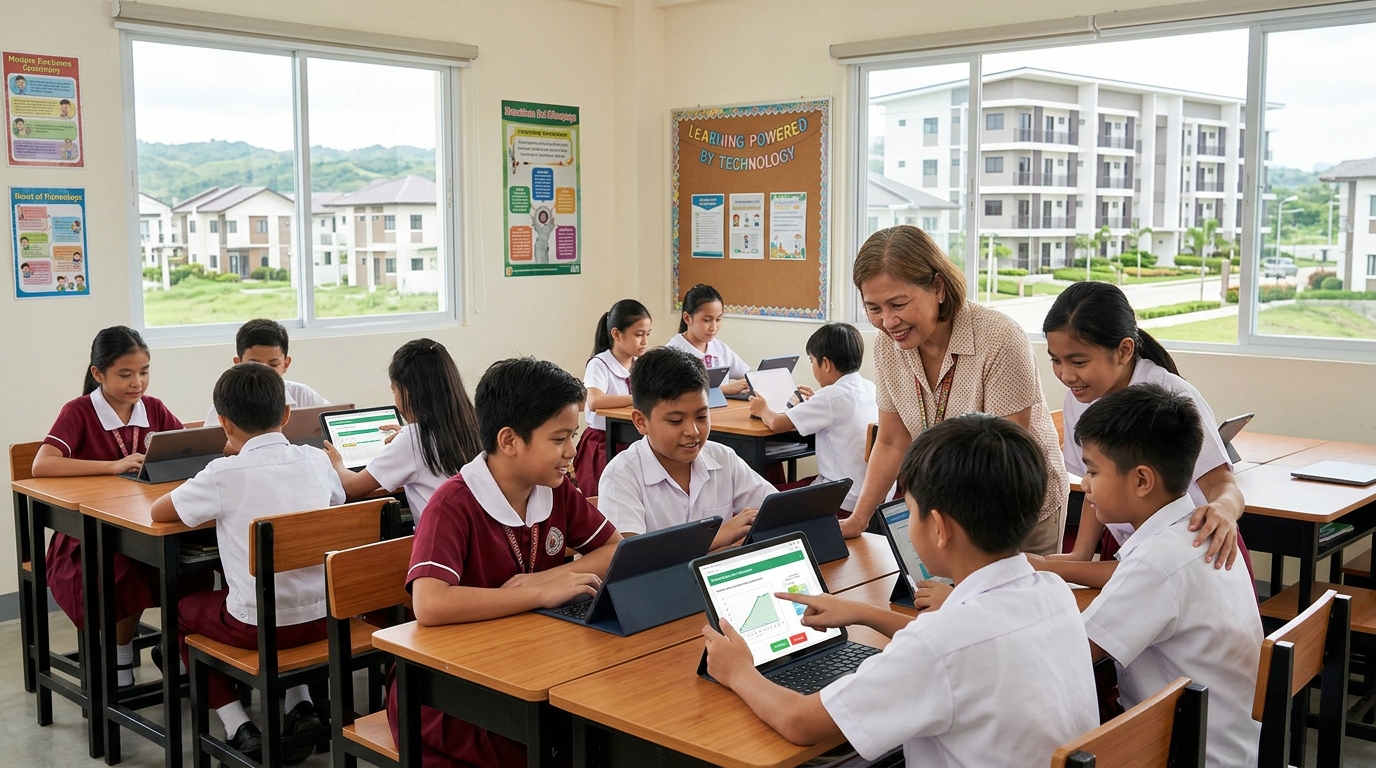
ILOILO CITY — A tripartite proposal to bring an artificial intelligence-driven learning platform to more than 1,050 public schools across Iloilo province is poised to redraw the province’s residential real estate map. On April 30, a delegation from Khan Academy Philippines, led by President and CEO Atty. Geraldine Acuña-Sunshine, presented a collaboration blueprint to the Iloilo Provincial Education Reform Group that would embed adaptive, data-driven instruction into classrooms from the upland towns to the coastal barangays. For property developers, investors, and families scouting home locations, the initiative signals that school quality may soon be measured not just by teacher-to-student ratios but by bandwidth and algorithmic precision.
The platform, already operating in over 2,500 schools nationwide and reaching more than 711,000 learners and 12,000 teachers, offers free lessons, exercises, and real-time progress tracking across subjects from mathematics and science to economics and history. DepEd Western Visayas has identified Iloilo as a priority region for education technology integration, with Secretary Sonny Angara’s office positioning the province as a model for how public school systems can absorb and scale digital learning tools. For the real estate sector, this is infrastructure news hiding in an education headline—because every classroom that goes smart raises the floor on what it means to live in a well-served neighborhood.
Smart Classrooms as the New Neighborhood Anchor
The proposed rollout rests on a practical foundation. Initial DepEd data indicate that at least 700 of the province’s 1,750 public schools already possess 30 or more devices, providing a ready base for scaling the AI-assisted system. Under the tripartite arrangement, DepEd would shoulder teacher training, logistics, and connectivity during implementation; Khan Academy would supply the curriculum-aligned platform, training design, and monitoring; and the provincial government would complement by supporting infrastructure improvements, including enhanced internet connectivity and learning resource augmentation.
Provincial Administrator Raul Banias expressed the government’s posture succinctly, noting the province’s readiness to back measures that enhance education quality and recommending that the proposal advance to Governor Arthur Defensor Jr. and the Provincial School Board for firming up. For homeowners and land speculators, this alignment of national, provincial, and private-sector players around a single education-technology goal functions as a de facto guarantee that the 1,050 target schools will not remain static institutions. They will become nodes in a digitally connected network, and as property market data consistently show, digitally equipped schools pull residential demand toward their catchment zones.
Proximity Premiums and the Rise of Education-Tech Catchments
Real estate analysts have long observed a “proximity premium” attached to residences near high-performing schools, but the Khan Academy model adds a new variable. Traditional school quality has been assessed by board exam results, facilities, and faculty credentials—metrics that change slowly. An AI-powered platform that delivers personalized instruction and real-time feedback, by contrast, can lift student outcomes within a single academic cycle. This acceleration compresses the timeline over which a neighborhood’s educational reputation improves, and with it, the timeline over which nearby property values respond.
Iloilo’s residential market is already absorbing high demand. Colliers Philippines reported that for the first quarter of 2026, Iloilo’s condominium take-up rate reached 89 percent, its house-and-lot take-up rate hit 96 percent, and lot-only purchases stood at 80 percent—all figures that outpace or match the Visayas-Mindanao average. The broader context supports continued appetite: 17 percent of OFW remittances received by households were allocated to real estate purchases in early 2026, according to the Bangko Sentral ng Pilipinas, while the Department of Human Settlements and Urban Development has been rolling out socialized housing across the province through initiatives like the Purok Resilience Village in Batad and the Luntiang Bukas land-titling program.
When families with purchasing power evaluate where to buy, school quality ranks high among decision drivers. The prospect that more than 1,050 public schools across Iloilo will soon carry an AI-driven learning platform with global credentials effectively rewrites the province’s education geography, turning once-overlooked school districts into competitive residential zones.
Infrastructure Dividends in the Countryside
The provincial government’s role in the partnership—specifically the commitment to enhance internet connectivity—carries a second-order real estate impact that extends well beyond school gates. Connectivity improvements funded to serve classrooms also make adjacent barangays more viable for remote workers, digital entrepreneurs, and business process outsourcing employees seeking provincial lifestyles. Developers who have been marketing subdivisions in Iloilo’s second- and third-class municipalities can now anchor their pitches on the dual narrative of accessible technology: smart schools for the children, stable broadband for the parents.
This pattern has precedent. When Megaworld integrated its Iloilo Business Park with the surrounding urban fabric, it did so by leveraging the city’s streamlined permitting, its compact multi-center growth model, and its deep bench of educated, English-proficient graduates. The Khan Academy initiative extends that logic into the province’s educational pipeline. By making AI-assisted, mastery-based learning standard across the public school system, the province is effectively building a future workforce that is comfortable with data interfaces, self-directed learning, and digital collaboration—traits that outsourcing firms and tech companies prize. Colliers Research Director Joey Roi Bondoc noted that Iloilo City continues to attract high-value outsourcing companies, a trend that regional developers are betting will sustain office and residential demand beyond 2026.
TAGS: