As Davao City celebrates its status as a global metropolis in 2026, its name remains a powerful linguistic bridge to its ancestral past. The term "Davao" is not a singular invention but a phonetic evolution born from the Davao River, which served as the lifeblood and primary trade artery for the indigenous Bagobo people. Historically, three distinct Bagobo subgroups each held a slightly different pronunciation for the river that defined their territory: the Obo referred to it as Davah, the Clatta (Giangan) as Dawaw, and the Tagabawa as Dabo. This reminds the locals and visitors alike that the city’s identity was never assigned by outsiders, but whispered by the river itself.
The Topography of 'The Place Beyond'
The etymological root Davah holds a specific topographical meaning, signifying "a place beyond the high grounds." This refers to the strategic settlement at the mouth of the river, which was physically shielded and surrounded by the rolling hills of the Mindanao interior. In early 2026, the Davao Historical Society released a digital mapping project illustrating how this "place beyond" acted as a natural fortress for the Obo, Clatta, and Tagabawa tribes. For the 2026 traveler exploring the city's highlands, understanding this "beyondness" provides a new perspective on why the river mouth was the inevitable site for what would become the largest city in the Philippines by land area.
Defying the Spanish 'Nueva Vergara'
When Spanish explorers led by José Oyanguren arrived in 1848, they attempted to impose the name Nueva Vergara on the settlement to honor Oyanguren’s home province in Spain. However, historical records recently highlighted in the 2026 Araw ng Dabaw exhibits show that the indigenous inhabitants and even early settlers largely ignored the European title. By the late 19th century, the sheer persistence of the local phonetic blend won out, forcing the colonial administration to officially recognize "Davao" as the settlement's name. This transition marks an early and significant act of cultural resilience, where the indigenous voice successfully overrode a colonial directive to maintain a name anchored to the actual landscape.
The River as a Modern Heritage Anchor
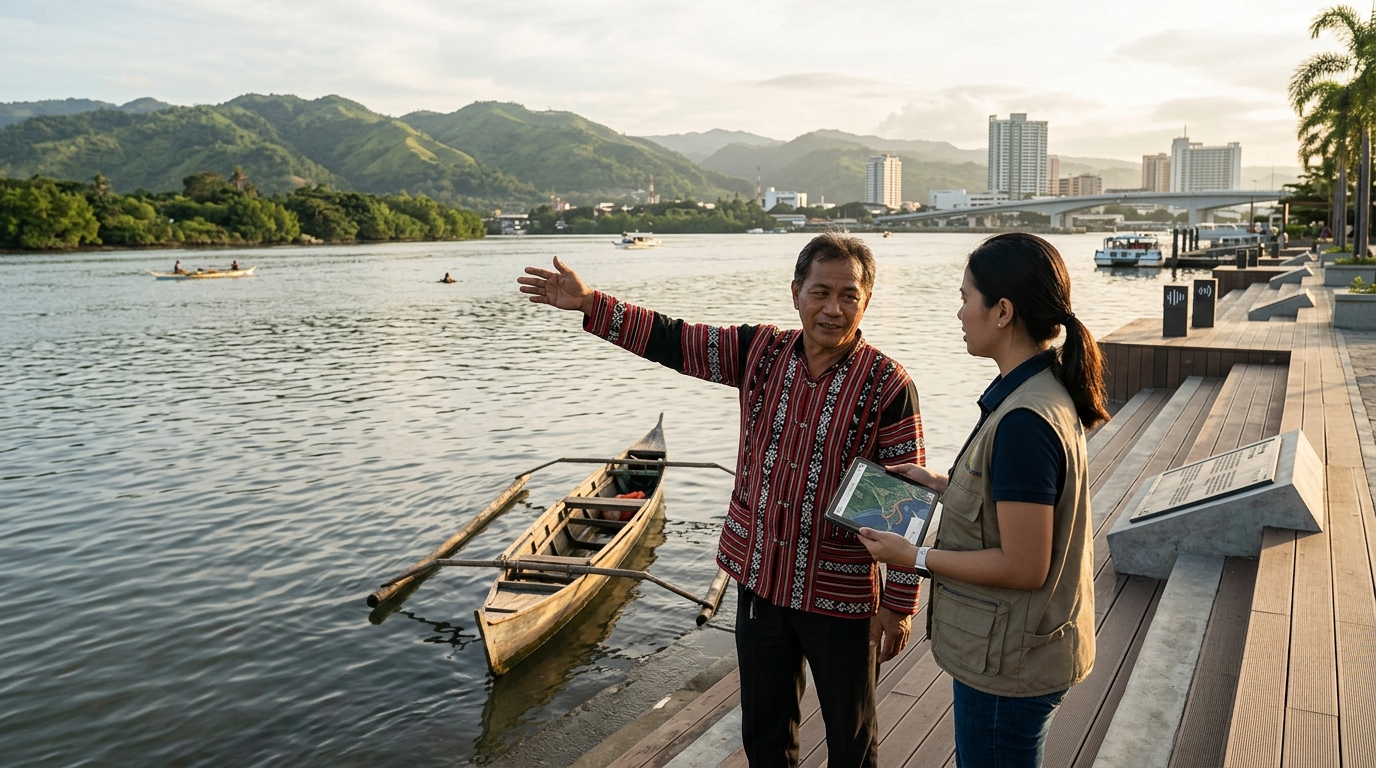
In May 2026, the Davao River is undergoing a massive rehabilitation and "Heritage Waterfront" development that honors its role as the phonetic source of the city’s name. The project includes interactive monuments at the river's edge that allow visitors to hear the distinct pronunciations of Davah, Dawaw, and Dabo recorded by elders of the Bagobo subgroups. This initiative is part of a broader effort to ensure that as Davao continues its rapid urban expansion, its 1.9 million residents do not lose sight of the three-part harmony that gave the city its title. By rooting the 2026 urban identity in the river’s trade history and indigenous dialects, Davao is positioning itself as a city that looks forward without ever forgetting the waters that named it.
TAGS: